



Next.js background jobs are units of slow, retryable, or resource-heavy server work that run outside the request that created them. The Next.js application validates a command, stores a small job in a durable queue, responds quickly, and lets an independently deployed worker process email, AI, media, import, or webhook work.
This publishing repository is PHP/Apache, not the example Next.js service. It contains no installed Next.js package, Redis client, BullMQ package, worker, scheduled job, Compose runtime, or production Redis connection. The downloadable starter uses floating next: latest, so an exact patch version cannot be verified. The code is production-oriented educational TypeScript; it does not silently install or deploy queue infrastructure.
- Blog #20Docker + TraefikPublished
- Blog #21Compose StackPublished
- Blog #22RedisPublished
- Blog #23Jobs + QueuesCurrent
- Blog #24MonitoringPublished
How Do Background Jobs Work in Next.js?
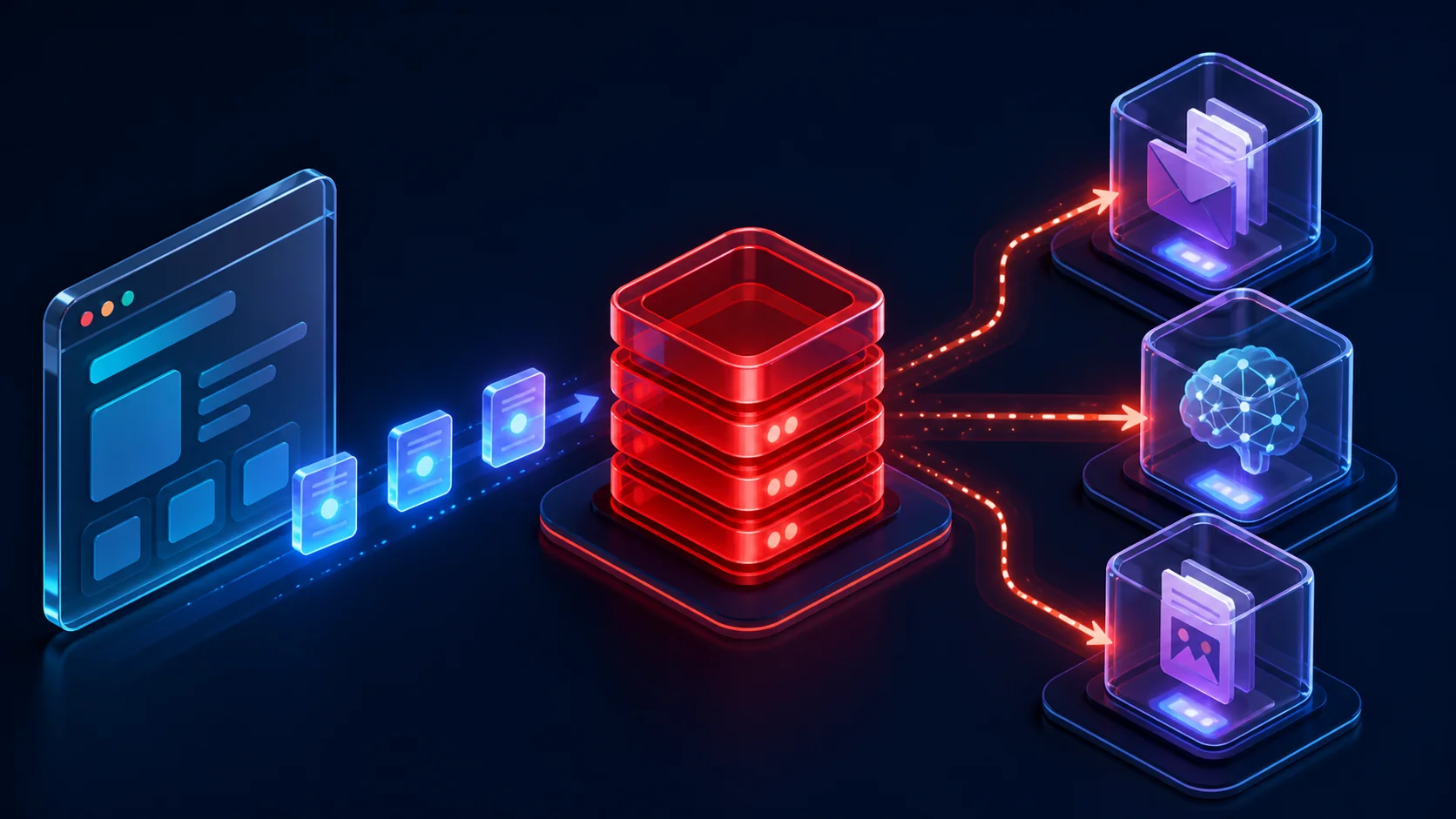
A Next.js background-job architecture sends slow or retryable work to a queue instead of completing it inside the HTTP request. The web application adds a job to a queue such as BullMQ backed by Redis, returns a response, and a separate worker processes the job asynchronously.
Why Next.js Apps Need Background Processing
HTTP requests have finite lifetimes. A browser can disconnect, a reverse proxy can time out, a serverless invocation can end, or a deployment can replace the process. Returning a response does not guarantee arbitrary in-process work will continue. A durable queue creates an explicit handoff, retry policy, concurrency limit, and observable lifecycle.
Good queue candidates
- Transactional email and batched notifications
- AI reports with provider rate and cost limits
- Image, video, PDF, and import processing
- Verified webhook fan-out and reconciliation
- Scheduled cleanup or report generation
Keep in the request
- Authentication and authorization decisions
- Validation needed to accept the command
- Fast authoritative database changes
- Data required to render the immediate response
- Work whose failure must reject the request
Next.js 16 also provides after(), which schedules code after a response or prerender finishes, and self-hosted next start waits for pending callbacks during graceful shutdown. That is useful for bounded post-response work such as logging. It is not a general durable queue: it does not replace persistent delivery, independent workers, retry/backoff state, workload smoothing, or queue observability.
Producer, Redis Queue, and Worker
The producer is trusted server-only Next.js code. BullMQ stores and coordinates jobs in Redis. A worker is a long-running Node process that imports the handler and listens to the exact same queue name. The browser never connects to Redis, and the worker normally exposes no public HTTP port.
Redis and BullMQ
Redis is infrastructure, not a complete job system by itself. BullMQ adds claiming, locks, retries, delayed jobs, concurrency, events, progress, and cleanup semantics. This guide uses BullMQ's Redis backend. Current BullMQ v6 also provides Redis client adapters and a PostgreSQL backend abstraction, so read the documentation for the exact major version you adopt rather than mixing v5 and v6 APIs.
Do not assume cache Redis and queue Redis have identical requirements. A cache may permit eviction and no persistence; important jobs may require noeviction, reviewed AOF/RDB persistence, replication, recovery tests, adequate memory, and a dedicated failure domain.
| Choice | Best fit | Operational review |
|---|---|---|
| BullMQ + Redis | Node workers, retries, scheduling, concurrency | Redis durability, memory, connections, worker deployment |
| Managed workflow/queue | Platform-native delivery and scaling | Runtime limits, delivery model, portability, cost |
| Database outbox | Atomic business write plus eventual dispatch | Dispatcher, polling/CDC, retention, ordering |
Install and Configure the Queue
In a real Next.js repository, pin reviewed versions using its existing package manager. The example below uses BullMQ's default Redis connection options; current BullMQ can also use supported Redis client adapters, whose reconnect and duplicate() behavior must meet worker requirements. Keep shared connection configuration in server/worker code, validate environment at startup, and never use a NEXT_PUBLIC_ queue credential.
npm install bullmq zodimport type { ConnectionOptions } from 'bullmq'
const redisUrl = process.env.REDIS_URL
if (!redisUrl) throw new Error('REDIS_URL is required')
const url = new URL(redisUrl)
const baseConnection: ConnectionOptions = {
host: url.hostname,
port: Number(url.port || 6379),
username: url.username || undefined,
password: url.password || undefined,
tls: url.protocol === 'rediss:' ? {} : undefined,
}
export const producerConnection: ConnectionOptions = {
...baseConnection, maxRetriesPerRequest: 1,
}
export const workerConnection: ConnectionOptions = {
...baseConnection, maxRetriesPerRequest: null,
}A manually supplied ioredis client used by BullMQ workers must use maxRetriesPerRequest: null so blocking consumers can reconnect. An HTTP producer should fail within a bounded time instead of making a caller wait indefinitely. Current BullMQ also supports client adapters; configure retry and duplication behavior according to the selected adapter and provider.
Create a Queue and Add Jobs
export const REPORT_QUEUE = 'reports-v1'

export type ReportJob = {
  schemaVersion: 1
  reportId: string
  accountId: string
}import 'server-only'
import { Queue } from 'bullmq'
import { producerConnection } from './connection'
import { REPORT_QUEUE, type ReportJob } from './contracts'
export const reportQueue = new Queue<ReportJob>(REPORT_QUEUE, {
connection: producerConnection,
defaultJobOptions: {
attempts: 4,
backoff: { type: 'exponential', delay: 2_000 },
removeOnComplete: { age: 86_400, count: 1_000 },
removeOnFail: { age: 604_800, count: 5_000 },
},
})import { z } from 'zod'
import { reportQueue } from '@/lib/queue/report-queue'
const inputSchema = z.object({ reportId: z.string().uuid() }).strict()
export async function POST(request: Request) {
const user = await requireUser(request)
const parsed = inputSchema.safeParse(await request.json())
if (!parsed.success) return Response.json({ error: 'Invalid request' }, { status: 400 })
await requireReportAccess(user, parsed.data.reportId)
const task = await createPendingTask(user.accountId, parsed.data.reportId)
await reportQueue.add('generate-report', {
schemaVersion: 1,
reportId: parsed.data.reportId,
accountId: user.accountId,
}, { jobId: `report-${task.id}` })
return Response.json({ taskId: task.publicId, status: 'queued' }, { status: 202 })
}Design Safe Job Payloads
A job payload is durable data that may appear in Redis, dashboards, logs, backups, and failed-job tooling. Store stable identifiers and a schema version, then load authorized current data in the worker. Do not store passwords, tokens, raw authorization headers, provider API keys, full private documents, or large binary files. Put files in object storage and enqueue an opaque object identifier.
- schemaVersion
- resourceId
- accountId
- safe options
- credentials
- raw files
- private content
- untrusted commands
Create a Separate Worker
import { Worker } from 'bullmq'
import { z } from 'zod'
import { workerConnection } from '../lib/queue/connection'
import { REPORT_QUEUE } from '../lib/queue/contracts'

const jobSchema = z.object({
  schemaVersion: z.literal(1), reportId: z.string().uuid(), accountId: z.string().uuid(),
}).strict()

const worker = new Worker(REPORT_QUEUE, async (job) => {
  const payload = jobSchema.parse(job.data)
  const claimed = await claimTaskOnce(job.id, payload.accountId)
  if (!claimed) return { status: 'already-processed' as const }
  await job.updateProgress(20)
  const result = await generateReport(payload.reportId, payload.accountId)
  await saveReportAndCompleteTask(job.id, result)
  await job.updateProgress(100)
  return { status: 'completed' as const }
}, { connection: workerConnection, concurrency: 4 })

worker.on('failed', (job, error) => {
  console.error('Report job failed', { jobId: job?.id, name: error.name })
})

async function shutdown(signal: string) {
  console.info('Closing worker', { signal })
  await worker.close()
}
process.once('SIGTERM', () => void shutdown('SIGTERM'))
process.once('SIGINT', () => void shutdown('SIGINT'))
The handler validates the durable payload again because queued data is still an input boundary. The worker receives only the database and provider permissions it needs. Logs contain an internal job ID and error category, never connection URLs, tokens, payload contents, or sensitive provider responses.
Job States, Retries, and Backoff
A typical job moves from waiting to active and then completed. A transient failure can move it back to a delayed retry; a permanent error or exhausted attempt count ends in failed state. BullMQ retains or removes records according to explicit policy. “Exactly once” should not be assumed: distributed workers provide at-least-once behavior in practical failure cases.
Retry network timeouts, temporary rate limits, and recoverable provider failures. Do not blindly retry invalid payloads, revoked access, unsupported file formats, or hard quota failures. Honor Retry-After when supported, add jitter for large fleets, and cap both attempts and total time.
Job IDs and Idempotency
A deterministic job ID can suppress duplicate additions while the original job exists, but it does not make side effects idempotent. A worker may send an email and crash before completion is recorded. Use an application idempotency key, a unique database constraint or atomic state transition, and provider-supported idempotency where available. Define ordering explicitly; multiple workers and retries can reorder independent jobs.
Concurrency and Horizontal Scaling
BullMQ concurrency lets one worker process several asynchronous jobs. It helps I/O-bound work but does not create more CPU. CPU-heavy image or PDF work should use worker threads, child processes, or specialized services with conservative limits. Calculate database, Redis, memory, file-descriptor, and provider capacity before increasing replicas.
Email, AI, Media, and Webhook Patterns
Email jobs
Enqueue a template name, recipient reference, locale, and idempotency key. Load current recipient data in the worker, suppress unsubscribed recipients, and avoid placing HTML, tokens, or credentials in Redis.
AI generation
Authorize and reserve budget before enqueueing. Limit concurrency by account and provider, enforce timeouts and output bounds, store results outside Redis, and distinguish safety rejection from transient provider failure.
Images and PDFs
Upload to object storage first, enqueue an object ID, scan and validate formats, restrict decompression and memory, process in an isolated workspace, then store a new immutable output reference.
Webhooks
Verify the signature against the raw request body before trusting or queueing an event. Record the provider event ID uniquely, respond quickly, and make downstream handling idempotent.
Delayed and Scheduled Jobs
delay is useful for one future attempt, such as a short follow-up. BullMQ v6 removed the legacy repeat APIs, so repeated schedules use the current Job Scheduler API. Schedulers still need one logical owner, timezone and daylight-saving decisions, catch-up behavior, overlap prevention, and idempotency. Next.js or a host can trigger cron-like endpoints, but cron is a trigger—not a durable execution engine.
await reportQueue.upsertJobScheduler(
  'daily-account-reports-v1',
  { pattern: '0 15 3 * * *', tz: 'UTC' },
  {
    name: 'generate-scheduled-reports',
    data: { schemaVersion: 1, reportId, accountId },
    opts: { attempts: 4, backoff: { type: 'exponential', delay: 2_000 } },
  },
)
A Job Scheduler produces the next delayed job when the preceding one begins processing, so a busy queue or insufficient worker capacity can make runs less frequent than the nominal interval. Monitor scheduler lag instead of treating it as a wall-clock guarantee.
Expose Safe Job Status
Do not give clients raw BullMQ job IDs, stack traces, payloads, or internal failure reasons. Store an application-owned task row with an opaque public ID, account ownership, safe state, bounded progress, and a user-facing error category. An authorized Route Handler can return queued, running, completed, or failed. Polling is often sufficient; Server-Sent Events or WebSockets add connection and authorization work.
Database and Queue Consistency
A database commit and Redis enqueue are separate operations. If the write succeeds but enqueue fails, the application can lose required work. The transactional outbox pattern writes the business change and an outbox row in one PostgreSQL transaction. A dispatcher later publishes unsent rows, records delivery, and retries safely. The consumer still remains idempotent.
Monitoring, Failed Jobs, and Backpressure
Monitor queue depth, oldest waiting age, job duration percentiles, throughput, retry rate, exhausted jobs, stalled jobs, active concurrency, event-loop lag, Redis latency and memory, worker restarts, downstream errors, and business completion rate. Queue depth alone can look healthy while one old tenant job is stuck.
Retain failed jobs long enough to diagnose and replay safely, but cap count and age. Alert on sustained age, failure ratio, and stalled processing. A dead-letter queue is useful only with an owner, redrive procedure, payload retention policy, and protection against replaying permanent or unsafe failures.
Graceful Worker Shutdown
On SIGTERM, stop accepting new jobs, allow active handlers to finish within the platform grace period, close the BullMQ worker, then exit. Make Kubernetes, Compose, or the process manager grace period longer than normal job completion or design checkpoints for longer work. A forced kill can lead to another delivery, which is why idempotency remains mandatory.
Docker Production Architecture
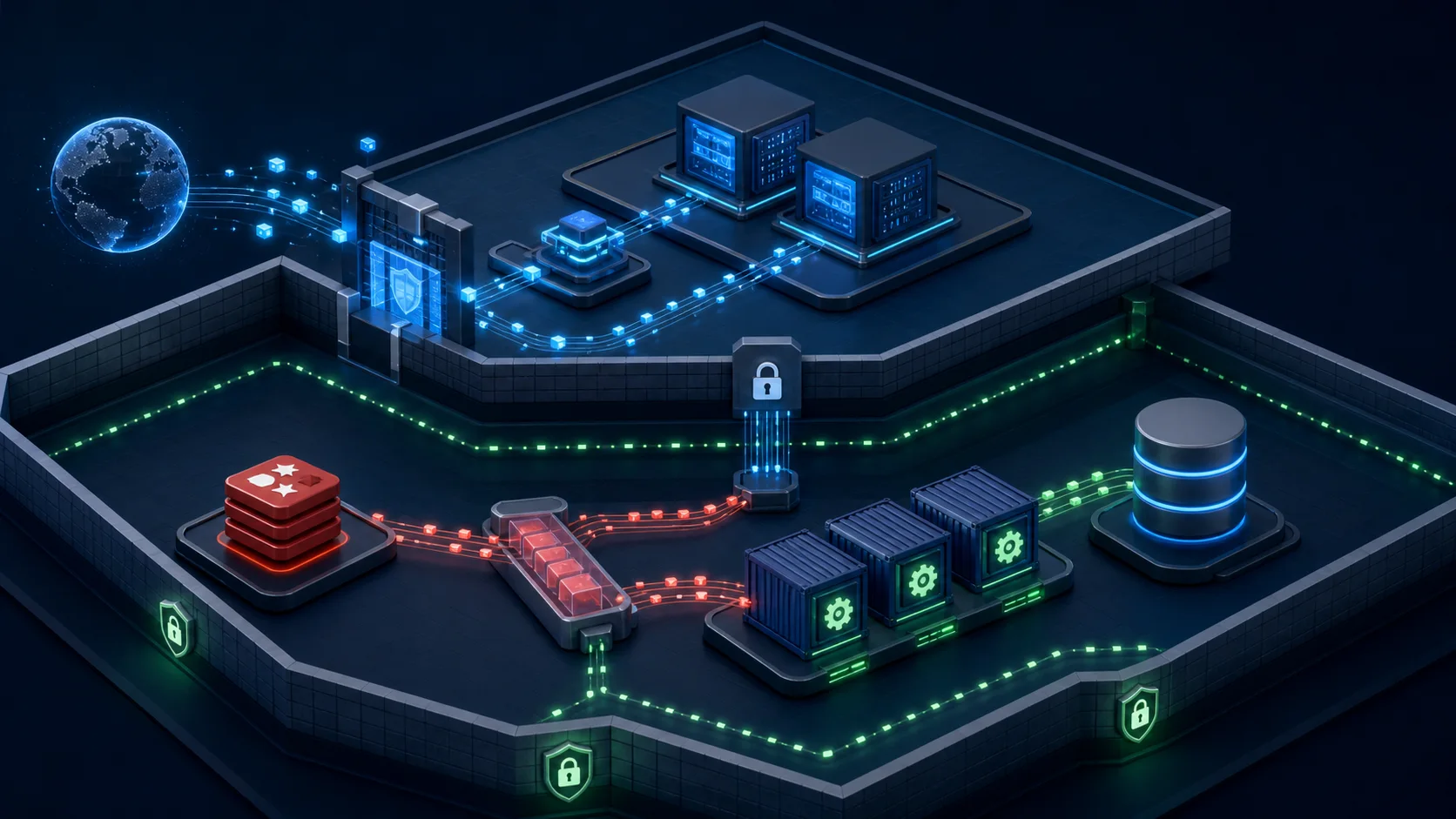
Build the web app and worker from the same reviewed source and immutable image, then select a different command. The web service joins the public proxy network and private application/data networks. The worker joins only private networks. Redis and PostgreSQL publish no host ports. The worker publishes no port at all.
services:
  app:
    image: registry.example/app:${APP_IMAGE_TAG:?required}
    command: ["node", "server.js"]
    networks: [proxy, app_private, data_private]
  worker:
    image: registry.example/app:${APP_IMAGE_TAG:?required}
    command: ["node", "dist/workers/report-worker.js"]
    restart: unless-stopped
    stop_grace_period: 60s
    networks: [app_private, data_private]
    # No ports: worker is not a public service.
  redis:
    image: redis:7.4-alpine
    command: ["redis-server", "--appendonly", "yes", "--maxmemory-policy", "noeviction"]
    volumes: [redis_data:/data]
    networks: [data_private]
  postgres:
    image: postgres:17-alpine
    volumes: [postgres_data:/var/lib/postgresql/data]
    networks: [data_private]
networks:
  proxy: { external: true }
  app_private: { internal: true }
  data_private: { internal: true }
volumes:
  redis_data:
  postgres_data:
The example is not copied into a live stack because this repository has none. Pin image digests or approved versions, supply secrets through deployment configuration, add real health/readiness behavior, test backup and recovery, and compile worker TypeScript as part of the image build. Do not run TypeScript directly in production without an intentional supported runtime.
Production Security Checklist
- Keep
REDIS_URLserver-only and out of logs. - Publish neither Redis nor worker ports.
- Authenticate and authorize every enqueue operation.
- Validate strict, versioned payloads at producer and worker.
- Keep secrets and sensitive content out of jobs.
- Use least-privilege database, storage, and provider credentials.
- Verify webhook signatures before trusting events.
- Redact provider errors returned to clients.
- Bound retries, job size, runtime, and concurrency.
- Enforce provider rate limits and cost budgets.
- Review Redis persistence and
maxmemorypolicy. - Retain failed jobs under a privacy-aware policy.
- Patch Redis, Node, BullMQ, and base images.
- Audit replay and administrative dashboard access.
Troubleshooting
| Symptom | Check | Safe action |
|---|---|---|
| Jobs remain waiting | Worker process, exact queue name, Redis reachability | Restore worker; do not delete jobs |
| Jobs become stalled | Event-loop blocking, process kills, lock renewal | Reduce CPU blocking; inspect idempotency |
| Retry storm | Permanent errors, provider outage, missing jitter | Pause admission and fix retry classification |
| Duplicate effect | Handler transaction and provider idempotency | Add durable idempotency, then replay carefully |
| Redis memory pressure | Retention, payload size, queue age, eviction policy | Stop unsafe admission; add capacity and cleanup policy |
| Slow web requests | Enqueue timeout and Redis connection exhaustion | Bound producer failure; repair capacity |
Common Next.js Background Job Mistakes
Fire-and-forget in a request
An unawaited promise is not a durable job. Process shutdown can discard it.
Homemade Redis list
A list alone does not provide safe claim, retry, lock, scheduling, or observation semantics.
Secrets or files in payloads
Jobs are durable operational data. Store opaque references and load protected data when needed.
Infinite retries
Permanent failure can create cost, noise, and provider pressure. Bound and classify retries.
Non-idempotent effects
Redelivery can duplicate emails, charges, webhooks, and database transitions.
Uncontrolled concurrency
Workers can exhaust PostgreSQL, Redis, memory, and third-party quotas.
Public worker or Redis
Neither needs a public port in the normal producer/consumer architecture.
No version strategy
Old jobs can survive a deploy. Version payloads and keep compatible consumers during rollout.
Next.js Background Job Best Practices
- Queue only work that can safely finish after the response.
- Use a maintained queue or workflow product instead of inventing reliability primitives.
- Run consumers separately from Next.js web processes.
- Validate, authorize, minimize, and version every payload.
- Make every externally visible side effect idempotent.
- Retry only transient failures with bounded backoff and jitter.
- Control concurrency from measured downstream capacity.
- Use object storage for files and PostgreSQL for authoritative task state.
- Use an outbox where a database write must reliably cause a job.
- Keep Redis private with intentional persistence and eviction.
- Design graceful shutdown and deploy compatibility.
- Monitor age, depth, duration, failures, stalls, capacity, and business outcomes.
Related Next.js Production Tutorials
- Blog #10: Route Handlers for authenticated HTTP producer boundaries.
- Blog #13: Authentication for session and authorization design.
- Blog #14: Performance Optimization for measurement and resource budgets.
- Blog #16: Environment Variables & Security for server-only credentials.
- Blog #18: Forms & Validation for strict untrusted-input validation.
- Blog #19: PostgreSQL + Drizzle for task state and transactional outbox data.
- Blog #20: Docker + Traefik for the public HTTPS edge.
- Blog #21: Docker Compose for private service networks and persistent data services.
- Blog #22: Redis Caching & Rate Limiting for Redis security, memory, persistence, and shared provider limits.
Frequently Asked Questions
What is a background job in Next.js?
It is slow, retryable, or non-interactive work that a Next.js server records for asynchronous processing instead of completing inside the HTTP request.
Does Next.js have a built-in job queue?
No general durable queue is built into Next.js. A deployment platform may offer scheduled functions or workflow products, while self-hosted applications can use a maintained queue such as BullMQ.
When should I use background jobs?
Use them for email, imports, webhooks, media processing, AI generation, reports, and other work that can outlive a request and benefits from retries or controlled concurrency.
When should I avoid a queue?
Avoid one for fast request-critical validation, simple database writes, work that must finish before the response, or systems that cannot operate another stateful dependency.
Can Redis be used for Next.js background jobs?
Yes. A queue library can use Redis for durable coordination between Next.js producers and separate worker processes. Do not build reliability semantics with a casual Redis list.
What is BullMQ?
BullMQ is a Node.js queue library with jobs, workers, retries, backoff, delayed work, concurrency, events, progress, and cleanup controls. This guide uses its Redis backend; current BullMQ also defines backend and client adapter interfaces.
How does BullMQ work with Next.js?
Server-only Next.js code validates and adds a small job payload. A separate Node worker using the same queue name and Redis deployment claims and processes that job.
Should the worker run inside my Next.js server?
Usually no. Run queue consumers as a separate process or service so web deploys, scaling, shutdown, resource limits, and failures remain independent.
Can I use the same Redis for caching and queues?
It is technically possible, but cache eviction and disposable durability assumptions can threaten important jobs. Review persistence, maxmemory, eviction, isolation, capacity, and failure domains.
How do I retry failed jobs?
Configure a bounded attempts count and a suitable backoff policy when adding the job. Retry only transient failures and keep handlers idempotent.
What is exponential backoff?
It increases the wait between attempts, reducing pressure on an unhealthy dependency. Add jitter when many jobs could retry together and honor provider retry guidance.
Why must background jobs be idempotent?
Delivery is generally at least once. A worker can fail after causing an external effect but before recording completion, so a repeated attempt must not duplicate the effect.
How do I show job progress in the UI?
Return an opaque public task ID, expose an authorized status endpoint backed by application-owned state, and poll or stream safe status without exposing queue internals.
How do I run workers with Docker Compose?
Build app and worker from the same immutable image, give the worker a distinct command, connect it only to required private networks, and publish no worker port.
How do I secure a background worker?
Keep it private, validate versioned payloads, minimize credentials, authorize enqueue operations, verify webhook signatures before enqueueing trusted work, and redact logs.
Current Official References
- Next.js self-hosting guide
- Next.js instrumentation and lifecycle guidance
- BullMQ connections
- BullMQ workers, concurrency, progress, and shutdown
- BullMQ retry and backoff
- BullMQ Job Schedulers
- Redis persistence
- Redis eviction policy
Next Steps
You now have a production model for asynchronous work: a trusted Next.js producer, a durable Redis-backed queue, separately deployed BullMQ workers, safe payloads, idempotent effects, bounded retries, controlled concurrency, and observable failures. Monitor that complete stack in Blog #24: Next.js 16 Monitoring & Observability.
