
Modern applications need to deliver data quickly. Whether you are building an e-commerce site, social network, AI application, or real-time dashboard, users expect information to appear almost instantly.
Relational databases such as PostgreSQL and MySQL are excellent for durable, structured data. Repeatedly performing the same database work can still add latency and load when an application handles thousands or millions of requests. This is where Redis can help.
Redis is an open-source, in-memory data store. It provides fast access to data held in RAM and supports caching, sessions, queues, real-time applications, and several useful data structures. It can also act as the primary database for workloads whose durability and data-model requirements fit Redis.
1. What Is Redis?
Redis stands for Remote Dictionary Server. Salvatore Sanfilippo created it in 2009 around a simple idea: keep frequently accessed data in memory so applications can retrieve and update it quickly.
Unlike a database whose persistence model is centered on disk storage, Redis performs normal operations against an active dataset in RAM. Simple commands can therefore complete with very low latency under suitable conditions.
Why was Redis created?
Interactive applications repeatedly need feeds, profiles, notifications, counters, sessions, and other hot data. Sending every request through the complete primary-database path can create avoidable work. Redis lets an application keep frequently requested or rapidly changing information in memory, improving response times and reducing pressure on its authoritative database.
2. How Does Redis Work?
Redis keeps its active dataset in RAM and can optionally persist data to disk. RAM offers faster access than SSD or HDD storage, while disk remains useful for durable snapshots, operation logs, and recovery.
| Feature | Traditional database | Redis |
|---|---|---|
| Primary data access | Disk and memory | RAM |
| Performance | Depends on queries, workload, and storage | Very low latency for supported operations |
| Data model | Tables or documents | Keys and data structures |
| Persistence | Usually built around durable storage | Optional RDB and AOF persistence |
| Common role | Authoritative application data | Cache, sessions, queues, real-time state |
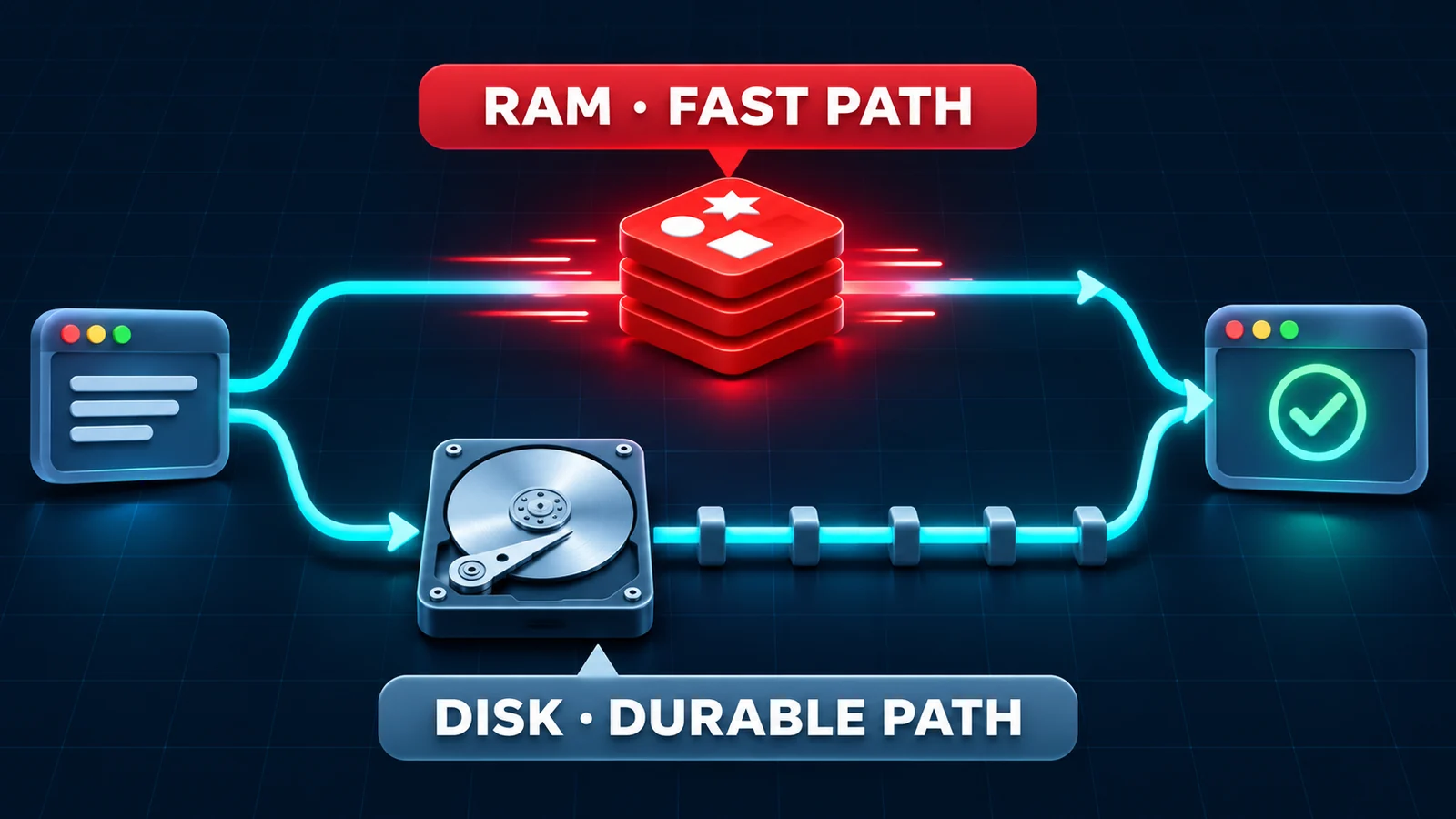
Memory is not unlimited, so capacity and cost matter. A production Redis deployment needs explicit memory limits, an eviction policy suited to the workload, and monitoring before the dataset reaches its limit.
3. How Does Redis Store Data?
Redis begins with a simple key-value model: every item has a unique key and an associated value.
SET username "navdeep"
GET username
SET creates or updates the key, while GET retrieves it. The result is "navdeep". This interface is easy to learn, but Redis is much more capable than a basic string store.
4. Redis Data Structures
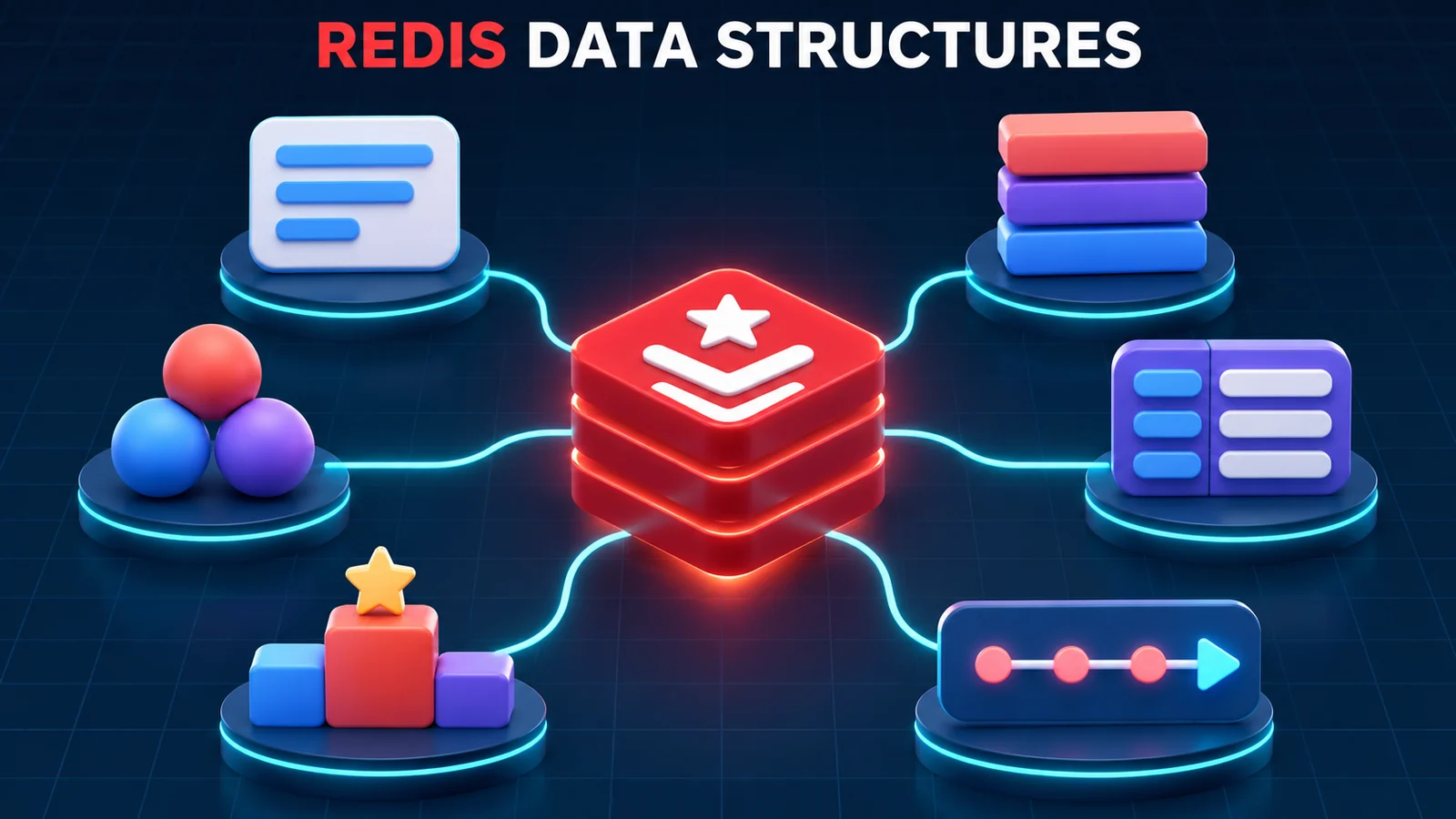
Redis provides purpose-built structures that let applications represent common kinds of data without repeatedly encoding and decoding everything as one generic object.
Strings
Strings can hold text, numbers, JSON strings, and binary-safe values. Typical uses include counters, configuration, sessions, and temporary values.
SET app_name "NavtechSolution"
GET app_name
Lists
Lists are ordered collections of strings. They are useful for simple task queues, recent activity, and ordered histories.
LPUSH tasks "Learn Redis"
LPUSH tasks "Learn Next.js"
LRANGE tasks 0 -1
Sets
Sets hold unique values without a defined order. They suit tags, interests, unique visitors, and membership checks.
SADD programming_languages "JavaScript" "Python" "TypeScript"
SMEMBERS programming_languages
Hashes
Hashes store field-value pairs inside one key, making them useful for profiles, products, settings, and other object-like records.
HSET user:1 name "Navdeep" role "Developer" country "Finland"
HGETALL user:1
Sorted Sets
Sorted Sets associate each unique member with a numeric score. Redis maintains score order, which makes them ideal for leaderboards, rankings, priorities, and popular-content lists.
ZADD leaderboard 100 "user1" 250 "user2" 180 "user3"
ZREVRANGE leaderboard 0 -1 WITHSCORES
Streams
Streams are append-oriented records for event processing, activity tracking, and real-time pipelines.
XADD orders * product "Laptop" status "created"5. Is Redis Just a Key-Value Store?
Calling Redis a key-value database is technically correct but incomplete. In addition to its core structures, Redis 8 brings JSON documents, search and querying, vector capabilities, time series, and probabilistic structures into Redis Open Source.
Those capabilities let teams store and query structured documents, process measurements, and build vector-powered features such as semantic search, recommendations, and retrieval-augmented generation.
6. Redis as a Primary Database
Redis is commonly used beside PostgreSQL or MySQL as a cache, but it can be the primary data store for suitable applications. Temporary sessions, live scores, analytics counters, shopping carts, and fast-changing state can align well with an in-memory model.
Redis does not automatically replace PostgreSQL. PostgreSQL offers relational constraints, joins, SQL reporting, and conventional transactional durability. Redis offers fast data-structure operations and real-time coordination. Many production systems deliberately use both: PostgreSQL remains authoritative while Redis handles hot, shared, or time-limited state.
7. How Does Redis Keep Data Safe?
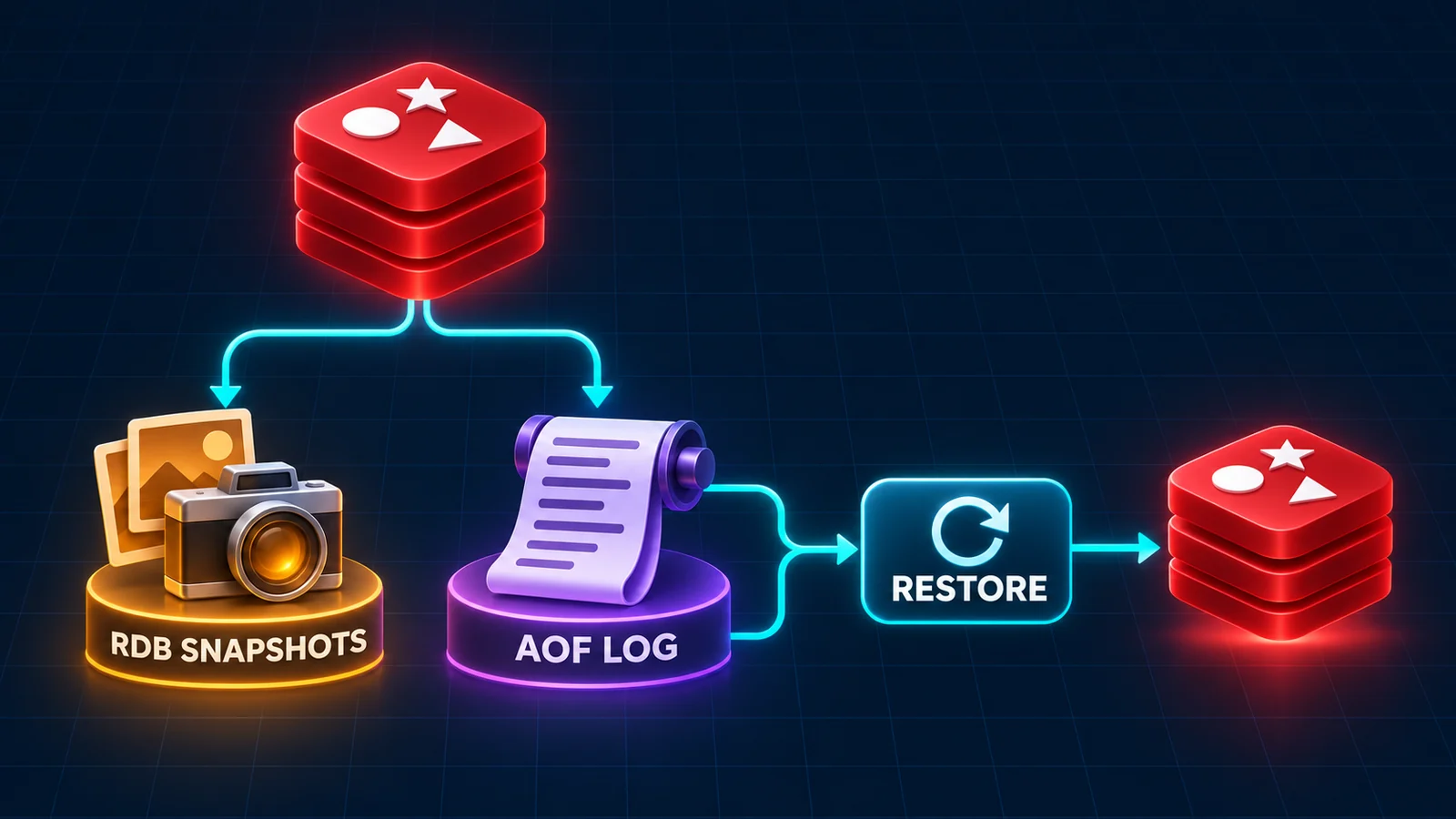
RAM is volatile, so its contents can disappear after power loss or a machine restart. Redis addresses this risk with two main persistence mechanisms.
RDB snapshots
RDB periodically writes a compact snapshot of the dataset, commonly to dump.rdb. Snapshots are useful for backups and can provide fast recovery, but changes made after the latest snapshot may be lost during a crash.
AOF logs
The Append Only File records write operations so Redis can replay them during startup. AOF can protect more recent writes depending on its synchronization policy, though the log is usually larger and recovery can take longer.
| Feature | RDB | AOF |
|---|---|---|
| Method | Point-in-time snapshots | Write-operation log |
| File size | Usually smaller | Usually larger |
| Recovery | Often faster | May take longer |
| Recent-write protection | Depends on snapshot interval | Depends on fsync policy |
| Typical role | Backups and recovery points | Stronger write durability |
Redis can use both mechanisms. Persistence, replication, and independent backups should be planned around the application's acceptable data-loss window and recovery objective.
8. Redis 8: More Than an In-Memory Cache
| Capability | Purpose |
|---|---|
| Strings | Simple key-value information |
| JSON | Structured JSON documents |
| Search | Full-text search and querying |
| Vector capabilities | AI similarity-search workloads |
| Time Series | Time-based measurements |
| Bloom Filter | Probable membership checks |
| Streams | Event-oriented records |
Vector search is especially useful for AI chatbots, recommendation systems, semantic search, and retrieval-augmented generation workflows.
9. Real-World Applications of Redis
- Caching: keep frequently requested results away from an expensive repeated query.
- Session management: store short-lived authentication and session state.
- Real-time analytics: update page views, active-user counts, and fast-moving metrics.
- Queues and messaging: coordinate jobs and event processing with the appropriate Redis structure or queue library.
- Leaderboards: rank users efficiently with Sorted Sets.
- Rate limiting: count requests inside a time window across application instances.
- AI applications: support search, retrieval, and vector-similarity workflows.
10. Get Started with Redis and Docker
Run Redis locally in a container:
docker run -d --name redis-server -p 6379:6379 redis:8Open the Redis CLI:
docker exec -it redis-server redis-cliStore and retrieve your first value:
SET developer "Navdeep Singh"
GET developer
For production, configure authentication, private networking, memory limits, persistence, monitoring, and backups rather than exposing an unsecured Redis port to the internet.
11. Connect Redis with Node.js
Install the official Node.js client:
npm install redisCreate a server-only reusable client:
// lib/redis.ts
import { createClient } from "redis";

const redis = createClient({
  url: process.env.REDIS_URL,
});

redis.on("error", (error) => {
  console.error("Redis connection error:", error);
});

export default redis;
Add the local connection URL to .env.local:
REDIS_URL=redis://localhost:6379Connect once when necessary, then reuse the client:
import redis from "@/lib/redis";

export async function getRedisData() {
  if (!redis.isOpen) await redis.connect();

  await redis.set("website", "NavtechSolution");
  return redis.get("website");
}
In production, account for the hosting environment's connection model and limits. Keep REDIS_URL on the server and never expose it through a public browser environment variable.
12. Should You Use Redis as Your Primary Database?
Redis is a strong choice when the workload needs low-latency access, high-throughput operations, shared counters, expiration, real-time processing, or specialized in-memory structures.
If the application needs complex relational queries, foreign keys, extensive SQL reporting, or a conventional transactional system of record, PostgreSQL or MySQL may be a better primary database. A practical design often combines a relational source of truth with Redis for the workloads where memory-speed access delivers a clear benefit.
Conclusion
Redis began with a focused idea: make data access fast by keeping active information in memory. It has grown into a data platform with rich structures, persistence, JSON, search, time series, and vector capabilities.
The important question is not whether Redis can replace every existing database. It is whether Redis is the right tool for the workload you are trying to solve.
